

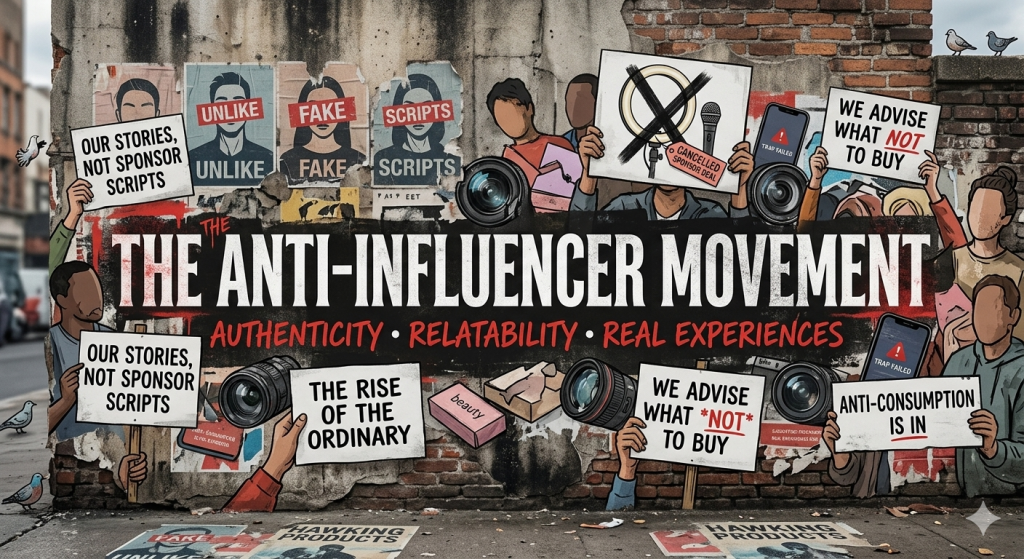
The Anti-Influencer Movement: Why Brands Are Betting on Everyday People
The era of polished influencer perfection is ending. In 2025, consumers are tuning out the glossy Instagram carousels and overly rehearsed YouTube hauls that dominated the past decade. According to recent industry data, 47% of consumers now find influencer content less authentic than five years ago, and engagement rates for sponsored posts have plummeted by 23% between 2021 and 2022. The backlash is real, and it’s reshaping how brands connect with audiences.
Welcome to the anti-influencer movement, a seismic shift where raw, unfiltered voices from ordinary people are replacing celebrity endorsements as the new currency of trust. Brands are no longer chasing millions of followers; they’re betting on everyday creators who command genuine influence within tight-knit communities. This isn’t just a trend, it’s a fundamental reckoning in marketing that’s redefining authenticity, trust, and consumer behavior.
Why Traditional Influencer Marketing Hit a Wall
The cracks in traditional influencer marketing have been widening for years. A 2024 Edelman. Trust Barometer revealed that only 50% of people globally trust businesses, down from 54% in 2022, driven largely by misinformation and overproduced marketing. When consumers encounter the same scripted endorsements across multiple platforms, skepticism sets in. The hashtag influencing has amassed over 686.6 million views on TikTok alone, reflecting a massive cultural pushback against overconsumption and inauthentic promotions.
Gen Z leads the charge. This digitally native generation demands transparency over perfection. Studies show that 67% of consumers are most compelled by influencer posts that come across as genuine rather than overly polished ads. More striking, 88% of people consider it critical that influencers genuinely care about the products they feature. When authenticity is questioned, engagement collapses. The anti influencing movement emerged as a direct response: everyday creators advising followers on what not to buy, challenging the relentless cycle of product promotion. The result? A fundamental shift in consumer psychology. People no longer want distant celebrities hawking products; they want relatable peers sharing honest experiences.
The Rise of Micro-Influencers and Everyday Creators
Enter micro-influencers: individuals with 10,000 to 100,000 followers who boast engagement rates that tower over their celebrity counterparts. While mega-influencers might reach millions, their actual engagement rates trend significantly lower. Research from Markerly found that as follower count increases, engagement rate decreases. Micro-influencers, by contrast, enjoy engagement rates often three to four times higher than macro-influencers and celebrities.
The numbers tell a compelling story. Nano-influencers (1,000-10,000 followers) achieve an average engagement rate of 2.71%, compared to just 0.61-0.87% for macro-influencers. This isn’t about vanity metrics, it’s about meaningful connections. Micro-influencers cultivate close-knit communities built on trust, where followers see them as peers rather than distant personalities.
Why do they work so well? Authenticity. Unlike celebrity endorsements that feel mercenary motivated, micro-influencers are more selective about brand partnerships. They don’t want to endorse products outside their niche, resulting in recommendations that feel genuine rather than transactional. Seventy percent of consumers put more faith in their peers and micro-influencers than in celebrities when it comes to recommendations.
Major brands have noticed. Coca-Cola, Nike, Sephora, Glossier, and Daniel Wellington all actively collaborate with micro-influencers to reach engaged audiences. In fact, 86% of U.S. brand marketers now work with micro-influencers, preferred 10 times more often than mega-celebrity influencers. This represents a massive pivot from the early days of influencer marketing when follower count was everything.
The ROI Advantage: Why Everyday People Deliver Better Returns
Beyond authenticity, the financial case for everyday creators is overwhelming. Micro-influencer campaigns consistently outperform macro campaigns on return on investment.
Higher conversion rates: Micro-influencers achieve approximately 20% higher conversion rates than bigger influencers. Even more striking, nano-influencers see roughly 7% of their engagements convert to sales, more than double the 3% conversion rate of macro-influencers. When an engaged follower comments or clicks, they’re twice as likely to make a purchase.
Cost effectiveness: Where a macro influencer might charge $5,000+ for one Instagram post, a micro-influencer might charge a few hundred dollars or even accept product gifts. This means brands can work with dozens of micro-creators for the cost of one celebrity endorsement. More importantly, the cost per engagement drops dramatically: micro-influencers average around $0.20 per engagement versus $0.33 for macro-influencers, a 40% cost savings.
Real-world results: A Stack Influence campaign for Blueland, an e-commerce brand, partnered with 211 micro-influencers and achieved a remarkable 13:1 ROI—every dollar invested returned $13 in revenue. Over three months, the campaign drove $129,280 in sales from a spend of approximately $9,917. While 13x ROI is exceptional, hitting 5-8x ROI with micro-influencers is common when campaigns are executed well.
Industry benchmarks confirm that businesses make about $5-$6.50 for every dollar spent on influencer marketing, but micro-influencer programs often exceed these averages. The data is clear: when it comes to financial returns, everyday creators deliver outsized impact.
